
Evidence-Based Meal Plan Template
Yet most meal planning templates online are just pretty grids. They tell you where to write "Tuesday dinner" but nothing about what actually makes meal planning work for your health.
This meal plan template is different. We built it around the evidence: the research on why planning helps, the Mediterranean Diet framework, and customizing meals for cholesterol, blood sugar, and weight, as well as convenience.
Below, you'll find the template itself (in editable Google Sheets, Excel, and printable PDF formats), plus a clear breakdown of how to use it. If you're a clinician, there's a version designed for patient handouts.
Why Meal Planning Actually Works (The Research)
We’ll show you how to prioritize time, money, AND your health.
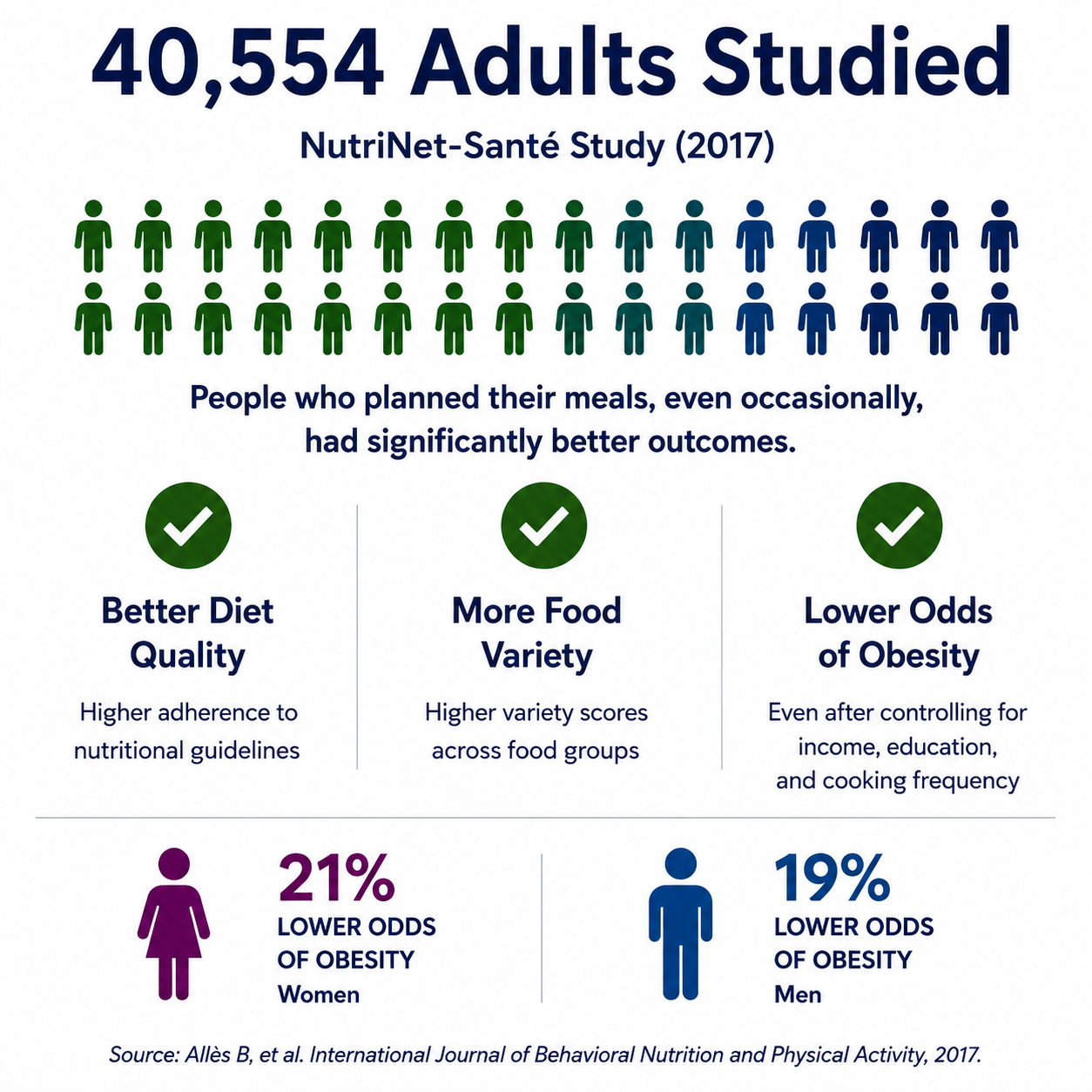
In 2017, researchers from the NutriNet-Santé study in France analyzed data from 40,554 adults. They found that people who planned meals, even occasionally, had significantly better adherence to nutritional guidelines and higher food variety scores than those who didn't plan.
The weight findings were notable too. Women who planned meals had 21% lower odds of obesity. Men showed 19% lower odds. These associations held even after controlling for income, education, and how often people cooked.
- What's driving this? The researchers pointed to several mechanisms:
- Reduced decision fatigue. When you've already decided what's for dinner, you're less likely to default to takeout or ultra-processed convenience foods when you're tired.
- Better grocery shopping. Planners buy ingredients with purpose. Non-planners buy the most attention-grabbing food, then figure out what to do with it, or don't.
- Increased variety. Without a plan, people tend to rotate through the same handful of meals. With a plan, you can deliberately include foods you might otherwise skip.
- Less reliance on food prepared away from home. Research consistently links restaurant and takeout food with lower diet quality and higher BMI. Planning nudges you toward cooking.
A note on the evidence: this was a cross-sectional study, meaning it captured a snapshot in time. We can't prove that meal planning causes better health outcomes. It's possible that health-conscious people are simply more likely to plan. But the association is strong enough, and the mechanisms plausible enough, that major health organizations now recommend meal planning as a practical nutrition strategy.
How This Template Is Designed (And Why It Looks the Way It Does)
Open most meal plan templates and you'll see a blank grid. Seven days, three or four meal slots, maybe a grocery list column. Simple, but not particularly useful if you're trying to improve your health.
Our meal plan template is structured around three evidence-backed principles:
1. The Mediterranean Diet Framework
Rather than following a generic “balanced plate,” this template is built around the Mediterranean Diet, the most studied dietary pattern in nutrition science, and the one with the strongest evidence for reducing heart disease, diabetes, and cognitive decline. The EBN Food Pyramid organizes this research into a practical visual guide.
The name “Mediterranean” can be misleading. This isn't about eating only Greek or Italian food. It's a set of principles derived from decades of research: prioritize vegetables, legumes, whole grains, fruits, nuts, and fish. Those principles work whether you're cooking Mexican, Indian, Japanese, or Southern American. The template organizes your weekly targets around these food groups.
2. Variety Tracking
One of the clearest findings from meal planning research is the link to food variety. But "eat more variety" is vague advice.
The template includes a simple weekly variety check aligned with the food groups at the base of the pyramid, the ones with the strongest evidence for health outcomes: vegetables, fruits, legumes, whole grains, nuts, and fish. At the end of each week, you check one question per group: “Did I hit this target?” (Yes / Partly / No). If you see “No” next to legumes two weeks in a row, that's useful information, and a clear action item for the following week.
3. The Daily Food Group Checklist
The foods with the strongest evidence for health outcomes (beans, berries, and greens) are the same ones most people consistently under-eat. Instead of tracking how you feel (which is influenced by sleep, stress, and dozens of other factors), this template asks three simple questions each day: Did you eat beans? Berries? Greens?
These three food groups sit at the pyramid’s foundation. Beans and legumes are linked to lower cholesterol, better blood sugar control, and longer lifespan in every Blue Zone population studied. Berries are among the most antioxidant-rich foods available. Dark leafy greens deliver fiber, vitamins, and minerals with almost no caloric cost.
Tracking these three daily is more actionable than a vague “eat healthy” goal. Over a few weeks, you’ll see clear patterns in how consistently you’re hitting the foods that matter most.
How to Use This Template: A Step-by-Step Approach
Step 1: Start With What You Already Eat
Don't try to overhaul everything in week one. Begin by writing down your current meals for a typical week, the ones you actually make, not the aspirational ones you've bookmarked.
This baseline shows you where you're starting. Maybe you'll notice you eat the same breakfast every day, or that dinners are heavy on refined carbs, or that vegetables only appear at one meal. That's useful information.
Step 2: Identify One or Two Improvements
Pick something specific:
“I want to include beans in at least two meals this week.”
"I want to remove processed meat."
Small, targeted changes are more sustainable than dramatic overhauls. People who attempt too much too fast tend to abandon their plans entirely.
Step 3: Build Your Week Around Anchor Meals
Most people have 2-3 meals that feel like the backbone of their week: maybe a Sunday batch-cook, a quick Tuesday stir-fry, a Friday pizza night. Plan those first.
Then fill in around them. If there are leftovers from Sunday's pasta night, Monday's dinner writes itself. If Tuesday is your busiest day, plan something that takes under 20 minutes.
Step 4: Create the Grocery List From the Plan
This is where planning pays off. Walk through each day's meals and list every ingredient you'll need. Check what you already have.
The template includes a grocery list section organized by store section (produce, protein, dairy, grains, pantry, frozen) because wandering aimlessly through a supermarket is how impulse purchases happen. There's also a "Restock Staples" checklist, a quick reminder of healthy pantry essentials (olive oil, garlic, canned beans, oats) so you never get home and realize you're missing the basics.
Step 5: Review and Adjust
At the end of each week, spend five minutes looking back. What worked? What didn't? Did you skip a planned meal because you forgot to thaw something?
The template includes a weekly reflection row for exactly this purpose. Use the Week # field to track your progress over time: week 1 won't look like week 8, and that's the point.
The best meal plan isn't the one that looks perfect on paper. It's the one you actually follow. Adjust based on what you learn.
Customizing Your Meal Plan Template for Specific Health Goals
The template works as a general meal planning tool, but you can adapt it for specific conditions. Here's how:
For High Cholesterol
Focus on three modifications:
Reduce saturated fat. This matters for everyone, not just people with elevated LDL. Saturated fat raises harmful cholesterol regardless of your current numbers. Examples of the most concentrated sources of saturated fat are coconut oil, butter, beef, beef tallow, cheese, and ice cream. Swap butter for olive oil. Replace processed meats with legumes. Limit full-fat cheese. For more on how cholesterol affects your health, see our cholesterol guide.
Avoid trans fats. Per gram, trans fats have an even greater impact on health compared to saturated fats. Fortunately, some countries, like the US, have banned added trans fats. However, many animal-based foods naturally contain a significant amount of trans fats. Common sources of trans fats are steak, butter, cheese, pepperoni, hamburgers, and ice cream. According to the National Academies of Science, “Any incremental increase in trans fatty acid intake increases coronary heart disease risk.” (ref)
Increase unprocessed plant foods. Whole grains, beans, nuts, seeds, fruit, mushrooms, and vegetables help decrease LDL cholesterol in the bloodstream. Fiber and plant sterols affect the way the body manages cholesterol and results in less harmful cholesterol circulating in the blood.
In the template, use the weekly variety check to ensure you're eating the foods that improve cholesterol.
For Blood Sugar Management
Research increasingly shows that your individual food choices matter more than broad macronutrient ratios like “high-carb vs. high-fat.” The clearest path to better blood sugar is reducing processed foods and foods high in saturated fat. These have the strongest links to poor glucose outcomes. For a detailed breakdown, see our blood glucose guide.
Several strategies have strong evidence behind them:
Reduce animal products. Diets high in meat, dairy, animal derived fats, like butter or beef tallow, result in higher rates of type 2 diabetes. Red meat consumption increases the risk of developing type 2 diabetes. Replacing one serving of red meat a day with nuts, low-fat dairy, or whole grains is associated with a 16-35% lower risk of type 2 diabetes.
Increase fruit. Many people think they should avoid fruit to improve their blood sugar management, when in fact, the opposite is true. Higher fruit consumption is associated with a significantly lower risk of diabetes. In fact, higher fruit consumption is associated with better health outcomes for people who have diabetes.
Make water the drink of choice. Sugar sweetened beverages are associated with higher type 2 diabetes rates. Replacing them with artificially sweetened drinks and fruit juices is not ideal. Water is the best replacement and the healthiest thing we can drink. Feel free to add a little squeeze of lemon or opt for a carbonated water if that tastes better to you.
Use the daily food group checklist to build consistent habits. Tracking whether you ate beans, berries, and greens each day is a practical way to ensure you’re getting fiber-rich, whole foods that support steady blood sugar.
For Weight Management
Meal planning's association with lower obesity rates likely comes from reducing unplanned eating rather than from any specific food rule.
A few strategies are well-supported:
Decrease hyperpalatable foods. Research from the University of Kansas defines hyperpalatable foods as those engineered to be difficult to stop eating: combinations of fat + sodium, fat + sugar, or carbs + sodium that override your body’s natural fullness signals. Chips, cookies, fast food, and many packaged snacks fall into this category. Reducing these is one of the most effective changes you can make, because they’re designed to encourage overconsumption.
Increase vegetables. Vegetables add bulk and nutrients without many calories. Filling half your plate with them naturally displaces more calorie-dense foods.
Don’t fear fruit. Many people avoid fruit worrying about the sugar, but the research tells a different story. Multiple large-scale studies have found that higher fruit consumption is associated with weight loss, not weight gain. The fiber, water content, and nutrients in whole fruit make it one of the most satisfying foods per calorie. If you’re craving something sweet, whole fruit is the evidence-based answer.
Plan snacks deliberately. Unplanned snacking is often where excess calories creep in. If you know you'll want something mid-afternoon, plan it: a small handful of nuts, some carrot sticks with hummus, a piece of fruit.
The template includes a snack row for this reason. Leaving it blank is fine, but if you do snack, having a plan helps.
For Clinicians: Using This Template With Patients
If you work with patients on nutrition, you're welcome to use the printable PDF version as a handout. (Learn more about how Evidence-Based Nutrition supports clinicians.)
A few suggestions based on how other clinicians have used it:
Start simple. For patients who've never meal planned, even filling in three dinners per week is a win. Don't overwhelm them with the full template on day one. Point them to the Sample Week sheet first. It shows what a filled-in week looks like.
Point patients to the daily checklist. The three questions (beans, berries, greens) are simple enough to remember without the template. Patients who track these daily build habits faster, and it gives you a measurable data point at each follow-up.
Use the variety check as a conversation tool. It's a low-pressure way to discuss food groups without lecturing. "I notice you marked 'No' next to, is that typical? What gets in the way of having it more often?"
Revisit the plan together. If you see patients regularly, reviewing their filled-out templates over a few weeks reveals patterns that self-report misses.
Common Mistakes (And How to Avoid Them)
Overcomplicating recipes. A meal plan full of elaborate dishes you've never made is a meal plan you won't follow. Include familiar meals alongside one or two new ones.
Ignoring prep time. Be realistic about weeknight bandwidth. If Tuesdays are chaotic, don't plan something that takes 45 minutes.
Not accounting for leftovers. Planned leftovers are efficient. Unplanned leftovers become waste. If you're making a big batch, assign the extras to a specific future meal.
Planning in isolation. If you live with others, get their input. A meal plan that ignores your family's preferences is a meal plan that generates complaints.
Treating the plan as rigid. Life happens. The goal isn't perfection. It's having a framework to return to when things go sideways.
Download the Meal Plan Template
We've created three versions to fit different needs:
NOTE: The main idea is to have one lead magnet ungated (for example meal plan spreadsheet) and other lead magnets gated, as a way to get leads through additional value offered.
Google Sheets (Editable Online) - Best if you want to access your plan from any device, share it with family members, or prefer typing to handwriting. Download the Google Sheets template]
Excel (Editable Offline) - Same structure as the Google Sheets version, but works without internet access.
Printable PDF (For Your Fridge or Clinic) - A clean, two-page format designed for printing: one page for your weekly meal plan, one for variety tracking and quick reference. Clinicians: this version works well as a patient handout. → [Download the printable PDF]
Bonus: The BS Detector Get the free BS Detector guide]

"Earn It, Return It"
It is simple to qualify!
1. Complete the program and improve at least one core biometric: LDL cholesterol, blood pressure, blood glucose or A1c, or weight for people with a BMI over 25. (Don't worry, almost everyone sees an improvement in one or more metrics.)
3. Complete the modules in the online program.
Once you do that, you will get 100% of your money back!
Dr. Paul N. Hopkins, MD, MSPH, FNLA
Dr. Hopkins received his medical training at the University of Utah and Mayo Graduate School of Medicine in Rochester Minnesota.
He is board certified in Public Health and Preventive Medicine as well as Clinical Lipidology.
Dr. Hopkins has been involved in efforts to promote greater understanding and prevention of premature, familial coronary artery disease (CAD) with the Cardiovascular Genetics (CVG) group since 1978. He has been a Principal Investigator (PI) or Co-Investigator for numerous NIH grants focused on the genetics of CAD, hypertension, lipids, diabetes, and metabolic syndrome. Dr. Hopkins is currently Co-Director of Cardiovascular Genetics at the University of Utah and Director of the Cardiovascular Disease Prevention Clinic.
From 1998 to 2004 Dr. Hopkins was International Chair for the MEDPED program (Make Early Diagnoses to Prevent Early Death), started by the late Dr. Roger Williams to find, educate, and help prevent premature CAD in persons with FH. Dr. Hopkins served as an NIH grant reviewer and continues to be a reviewer for numerous medical journals. He teaches at the University of Utah School of Medicine, is an active lecturer, and serves as a statistical consultant for the Center for Clinical and Translational Studies statistics group at the University of Utah.