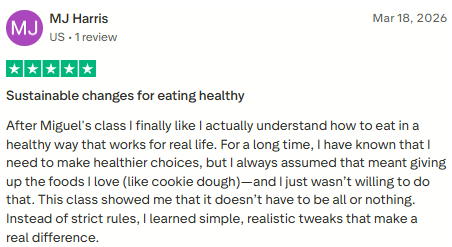
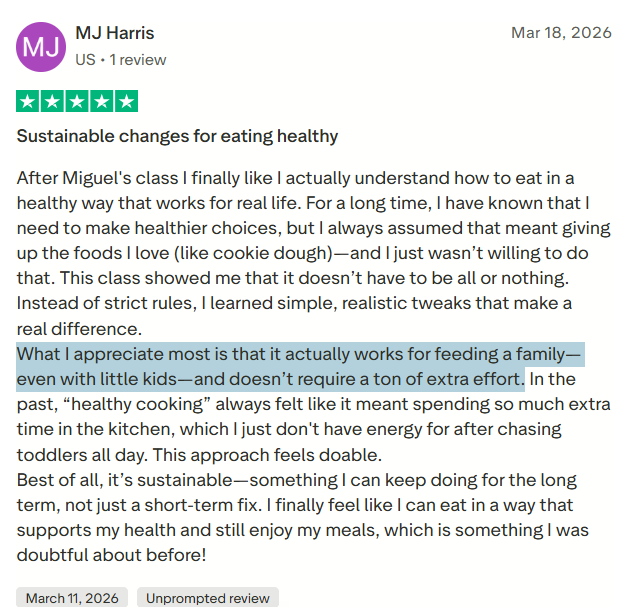
You thought you were eating right. Then your bloodwork said otherwise.
- 15-minute daily video
- Community support
- Never give up up the foods you love
Your Instructor
To learn more about the Mediterranean diet and blood sugar control, click here.
Nobody handed you a map
They go into their doctor appointment feeling fine. Their physician only has a few minutes to tell them about their lab results and that they should try losing some weight and cutting back on the the carbs. Then they go home worried and feeling like they don't have a plan.
The obvious thing to do is research how to improve blood sugars online and the internet answers with a fight. One camp says carbs are the enemy and you should never eat bread again. Another says fat is the enemy and everything must be low fat. Someone in a Facebook group swears by eating only meat. Every voice sounds certain. Every voice says the others are dangerous. And almost all of them agree on one thing, that the answer is giving up entire categories of food, forever, and eating in a way no normal life can hold.
Meanwhile the condition itself stays quiet. No pain. No symptom. No daily reminder. Just a recheck with the doctor six months away, which makes it easy to keep researching and hard to start.
The best results are not from extreme dieting
For most people the problem isn't willpower. It's our environment of contradictory advice. The solution is a plan built on evidence you can check, that fits the life you already have.
Now picture the next blood draw
You drive home. You tell your family in the kitchen. And for the first time since the diagnosis, the number is on your side.
Now picture the part nobody expects. Bread is still on your table. Dessert still shows up on birthdays. There is no forbidden-foods list taped to your fridge, because the eating pattern behind that bloodwork was never built on giving things up. It was built on what you add.
One of our participants learned to make risotto during the program. His proudest post was a photo of it. Asked what keeps him eating this way, his answer was six words:
You can learn how to adapt this pattern to your life. What's been missing is someone to teach it to you, step by step.
That's what Thrive-in-5 was built to do.
Most diets start with a belief.
This starts with the research.
Low-fat believes fat is the problem.
Carnivore believes plants are the problem.
Thrive-in-5 doesn't ask you to join a camp. It teaches the whole-food Mediterranean-style eating pattern, one of the most studied eating patterns in nutrition science, examined for decades in published research and linked in that research to improvements in blood sugar (Huo, 2015), cholesterol (Estruch, 2018), blood pressure (Toledo 2013), and weight (Schwarzfuchs, 2012). It's also the pattern people are still following years later, because nothing about it requires giving up bread, or dessert, or dinner out.
This is a dietary pattern. That means it can be applied to any cuisine and any preference. You're not restricted to an ideology. You're learning how to make healthy choices for your unique situation.
The team behind Thrive-in-5
Dr. Gardner is a professor of Medicine at Stanford University who has spent decades leading randomized nutrition intervention trials. He is well known for his study on the ketogenic and Mediterranean diets for controlling blood sugars (Gardner, 2022). He is regarded as one of the top nutrition scientists in the world due to his scientific contributions.
Dr. Tobias is an obesity and nutritional epidemiologist at Brigham and Women's Hospital and Harvard Medical School. Her research is dedicated to identifying dietary and lifestyle risk factors and underlying mechanisms for the prevention of obesity-related chronic diseases, particularly Type 2 diabetes and cancer.
Dr. Kalwaney, a practicing physician, Board certified in Internal Medicine and Lifestyle Medicine. One of her specialties is helping patients make changes to their diet to improve their health, and she educates other physicians on how to introduce those skills to their practice.
Thrive-in-5 Instructor
I built Thrive-in-5 by going to these researchers and physicians with one question: what does the evidence say people should eat, and how do we make it teachable? This program is so easy to follow and gets such consistent results, that physicians from across the US send their patients to us. If you decide to join, I hope to meet you. (Yes, I meet with every participant who reaches out.)

Hi, i'm scoop! I help make the recipes we provide.
Even doctors can have high blood sugar
What happens in the 5 weeks of Thrive-in-5
Nutrition Masterclass
What everyone should know about nutrition:
How much does nutrition matter to your health
How do you tell good information from marketing
How to make small changes that have big results
Learn how a Mediterranean-style pattern adapts to your preferences instead of replacing them. You'll also write your North Star Statement, the one-sentence reason you're doing this, which stays with you when motivation dips.
Protein and muscle
Protein is the hot topic of today, so what actually matters when you take away the marketing?
How much protein do you need
How does protein affect strength
Who isn't getting enough protein
Make it automatic
The habits that help us eat better every day
The science of getting full during meals
The science of staying full between meals
The power of fiber and how to ease into it
Real life
Learn about the foods that are the healthiest and the least expensive. (Many participants save enough money in the first few months to pay for the program.)
Learn how to make healthy choices in social situations while still being able to enjoy your food and the people around you:
Parties and holidays
Holidays
Restaurants
The long game
The choices we can make every day to reduce our chances of getting the most feared chronic diseases:
Dementia & Alzheimer's
Cancer
Heart disease
What happens in the 5 weeks of Thrive-in-5
Nutrition Masterclass
What everyone should know about nutrition:
How much does nutrition matter to your health
How do you tell good information from marketing
How to make small changes that have big results
Learn how a Mediterranean-style pattern adapts to your preferences instead of replacing them. You'll also write your North Star Statement, the one-sentence reason you're doing this, which stays with you when motivation dips.
Protein and muscle
Protein is the hot topic of today, so what actually matters when you take away the marketing?
How much protein do you need
How does protein affect strength
Who isn't getting enough protein
Make it automatic
The habits that help us eat better every day
The science of getting full during meals
The science of staying full between meals
The power of fiber and how to ease into it
Real life
Learn about the foods that are the healthiest and the least expensive. (Many participants save enough money in the first few months to pay for the program.)
Learn how to make healthy choices in social situations while still being able to enjoy your food and the people around you:
Parties and holidays
Holidays
Restaurants
The long game
The choices we can make every day to reduce our chances of getting the most feared chronic diseases:
Dementia & Alzheimer's
Cancer
Heart disease
How do you know if this program is working?

Seeing your numbers change is incredibly motivating.
Thrive-in-5 comes with a full year of this
Other people on the same journey swapping recipes, sharing tips, and celebrating each other's results. Get the support and accountability you need to be successful with your goals.
A two-week meal plan with more than 70 recipes, plus a builder that generates recipes around your preferences, restrictions, budget, and time.
Every student gets live access to me, so send me questions or set up a call. If I don't know the answer, someone on our Scientific Advisory Board will know.
Download quick reference sheets that you can print out and put on your fridge.
Receive weekly videos to keep you excited about healthy choices.
All of it runs in your browser on any phone, tablet, or computer. Nothing to download.
What happened when 26 people tried Thrive-in-5
5 had prediabetic blood glucose
7 had stage 2 hypertension
12 had high cholesterol
0 had prediabetic blood glucose
1 had stage 2 hypertension
4 had high cholesterol
Remember that these people were already active. And what changed was their diet. Regular exercise does not make up for a poor diet.


How does the price of Thrive-in-5 compare?
Price of doing nothing
People with prediabetes spend roughly $500 more per year on healthcare than people without it, on average (Dall, 2019). This is because prediabetes affects our overall health.
Up to 70% of individuals with prediabetes will eventually develop type 2 diabetes (Tabák, 2014). This is why we urge everyone with prediabetes to seek help before the disease progresses.
People with type 2 diabetes have an additional $12,022 a year in medical expenses (Parker, 2024). This could explain why a large portion of people with type 2 diabetes experience financial hardship from medical bills (Caraballo, 2020).
Visit our Value Estimator to learn more.
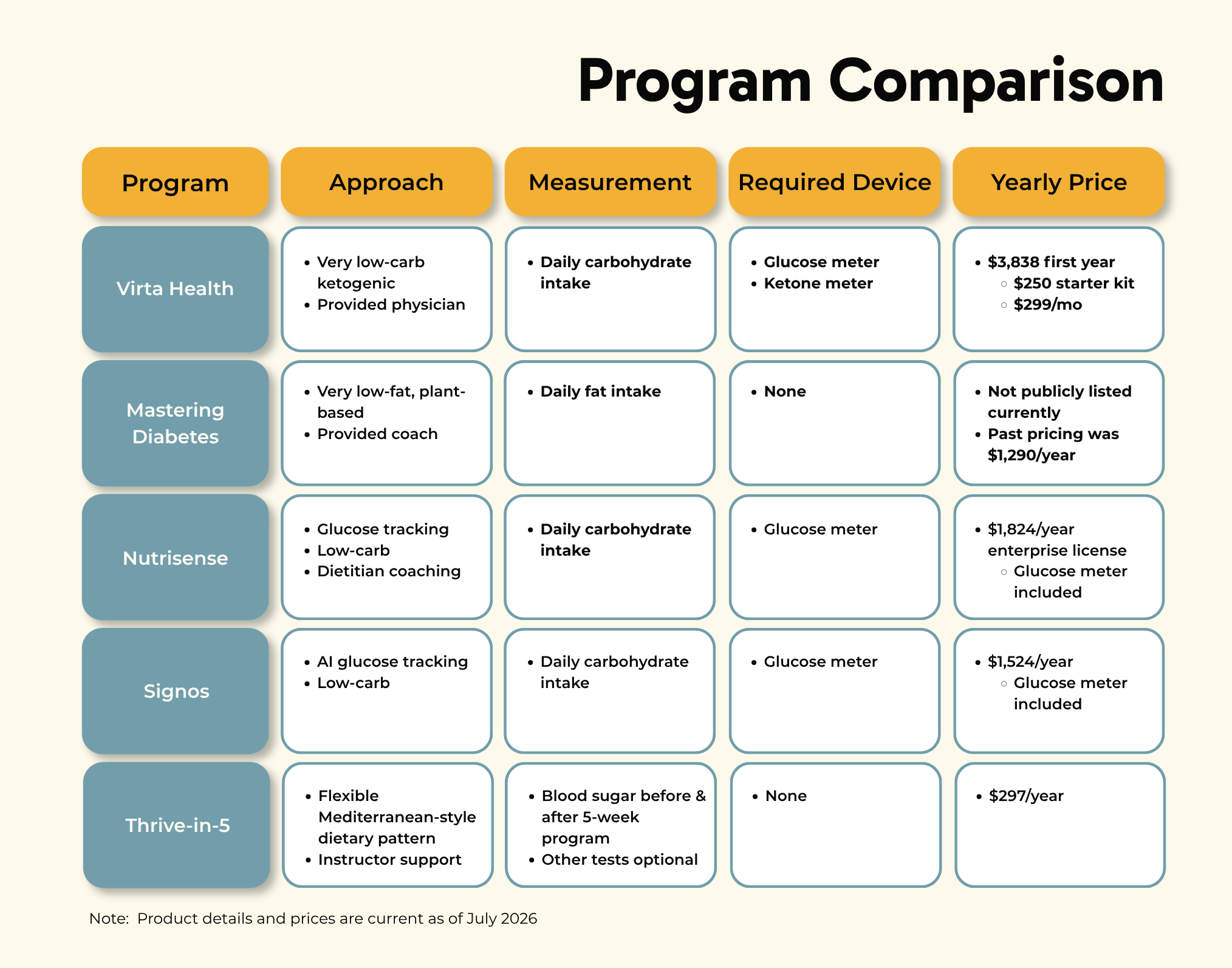
There are other programs for blood sugar control. You'll find that their methods are quite different from ours. one major difference is that they are focused on counting. They want you to count your carbs, grams of fat, calories. Measuring and counting everything you eat is stressful, exhausting and not sustainable. Our methodology teaches simple rules that quickly become habits so you can just sit down and enjoy a meal with your friends, no need to put your food on a scale.
Many programs want to sell you a continuous glucose monitor (CGM). For people with Type 2 diabetes these devices can be very helpful but only under the close supervision of a physician because interpreting the results is counterintuitive.
We always encourage people to work with their physician for guidance on what they should measure and how often they should do it. However our program does encourage everyone to get blood work done before and after the program so they can see the results of their efforts.
See how thrive-in-5 compares to other programs.
This program teaches you to spend less at the store. Whole-food, Mediterranean-style eating is built on some of the least expensive foods in the supermarket, beans, lentils, oats, frozen vegetables, whole grains. Many participants find the grocery savings offset the program price in the first couple of months. (Visit our Value Estimator to learn more.)
It's great that this program can save you money but what's more important is the value of focusing on your health. People want to spend time with their grandkids, be able to dance at their daughter's wedding, and enjoy the time in retirement that they've worked so hard to earn. As they say: "You either invest in your health now or you pay for it later."
The five questions you're probably asking
"Why is this a subscription?"
"Why would I pay when the internet is free?"
There's a second problem with free, and one of our participants lived it:
"I've tried making changes before, and my numbers got worse."
Thrive-in-5 makes teaches the most studied eating pattern and has a track record of improving biometrics. That's why nearly every participant who has completed the program has improved at least one biomarker. We can't promise you'll be one of them. What we can do is take the risk off you entirely, which is why we have guarantees (see below).
"Am I going to feel like I'm starving and missing out on great food."
Thrive-in-5 was made by "foodies" who want to share how to love food. Food is a joy that we should be exerpiencing multiple times a day!
Everything else you might be wondering
I have type 2 diabetes. Is this for me?
My doctor didn't give me any guidance. Should I still involve them in what I'm doing?
If you don't have a doctor, we can provide resources for finding doctors who have been trained on how to incorporate nutrition into their practice.
How much time does it take?
I'm not comfortable with technology.
I'm not much of a cook.
My family won't eat health food.

What does prediabetes actually cost, money-wise?
When can I start?
_________
The two guarantees that cover this investment into your health
Complete the program and activities
Share your experience (can be done over social media or letting us interview you)
Improve at least one core biomarker (LDL cholesterol, blood pressure, glucose or A1c, or weight if your BMI started over 25.)
Then the money will be sent back to your card. Simple!
People sometimes expect the opposite, a refund only if the program fails you. We built it the other way on purpose. Nearly everyone who completes the program improves a biometric, and when you share that, someone else finds out this is possible. Your win becomes the next person's reason to begin. It is a virtuous cycle that helps us with our mission of helping as many people as possible.
This is the bet on yourself guarantee. Do the work, see a result, get your money back.
Refunds go back to your original card and typically appear within five to ten business days.
In short, if the program works and you do the work, you can get every dollar back. If you aren't satisfied, you get every dollar back.
_______
Prioritize your nutrition and start today.
This is the most important section!
DO NOT SKIP.
High blood sugar is serious. Prediabetes is associated with a higher risk of dementia, heart disease, stroke, cancer, kidney diseases, depression, and vision loss1-7. Up to 70% of people with prediabetes go on to develop type 2 diabetes if they don't get treatment8, and type 2 diabetes has even worse health outcomes.
I know too many people who got this diagnosis, felt fine, so they did nothing. Not because they didn't care, but because nothing hurt yet. I get it. Life is busy and your next doctor appointment is months away.
Please don't join them. Do something right away. Do it for yourself and for your loved ones who want you in their lives!
I want you to know that your choices are powerful and that there is so much you can do to improve your health. It's so easy to feel helpless especially if you've tried things before that don't work. But I see people making a difference in their health every day. They are people just like you who are busy battling the stresses of daily life. They set aside a few minutes each day to take care of their most important asset – their health. You can do it too!
Whatever you decide today, decide to prioritize your health because you deserve it. And if you decide to start this program with us, I'll see you inside.
Founder, Evidence-Based Nutrition
2. https://pubmed.ncbi.nlm.nih.gov/32669282
3. https://pubmed.ncbi.nlm.nih.gov/32669282/
4. https://pubmed.ncbi.nlm.nih.gov/25208757/
5.https://www.bjbms.org/ojs/index.php/bjbms/article/view/13524
6. https://journals.plos.org/plosone/article?id=10.1371/journal.pone.0307428
7. https://pubmed.ncbi.nlm.nih.gov/35093270/
8. https://pubmed.ncbi.nlm.nih.gov/22683128/
Dr. Monique Cho
"Earn It, Return It"
It is simple to qualify!
1. Complete the program and improve at least one core biometric: LDL cholesterol, blood pressure, blood glucose or A1c, or weight for people with a BMI over 25. (Don't worry, almost everyone sees an improvement in one or more metrics.)
3. Write an online review.
Once you do that, you will get 100% of your money back!
Dr. Paul N. Hopkins, MD, MSPH, FNLA
Dr. Hopkins received his medical training at the University of Utah and Mayo Graduate School of Medicine in Rochester Minnesota.
He is board certified in Public Health and Preventive Medicine as well as Clinical Lipidology.
Dr. Hopkins has been involved in efforts to promote greater understanding and prevention of premature, familial coronary artery disease (CAD) with the Cardiovascular Genetics (CVG) group since 1978. He has been a Principal Investigator (PI) or Co-Investigator for numerous NIH grants focused on the genetics of CAD, hypertension, lipids, diabetes, and metabolic syndrome. Dr. Hopkins is currently Co-Director of Cardiovascular Genetics at the University of Utah and Director of the Cardiovascular Disease Prevention Clinic.
From 1998 to 2004 Dr. Hopkins was International Chair for the MEDPED program (Make Early Diagnoses to Prevent Early Death), started by the late Dr. Roger Williams to find, educate, and help prevent premature CAD in persons with FH. Dr. Hopkins served as an NIH grant reviewer and continues to be a reviewer for numerous medical journals. He teaches at the University of Utah School of Medicine, is an active lecturer, and serves as a statistical consultant for the Center for Clinical and Translational Studies statistics group at the University of Utah.